Faculty & Conference Details
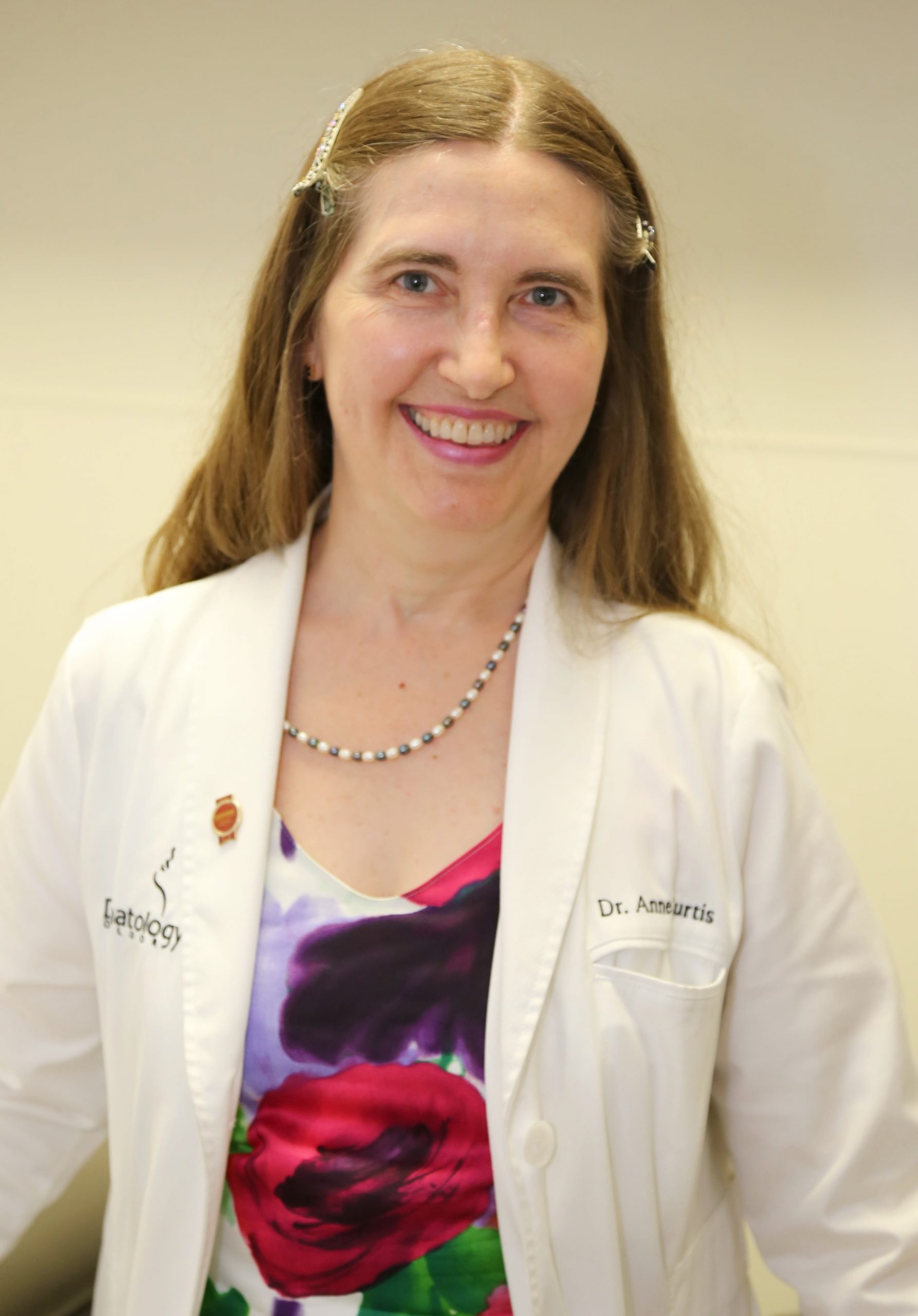
Dr. Anne Curtis
Specialty:
Dermatology
About The Speaker
Dr. Anne Curtis is a Toronto dermatologist who has transitioned from a busy general dermatology practice to one in cosmetic and laser dermatology. She graduated from medical school at the University of Toronto in 1982 and was awarded the Cody Gold Medal for the highest standing over 4 years of medical school. She then completed a fellowship in Internal Medicine at the University of Western Ontario, where she was Chief Resident at University Hospital. Dr Curtis then returned to the University of Toronto where she completed her dermatology training in Toronto and Hamilton. In addition to her Canadian fellowships, she has her American Board certifications in Internal Medicine and Dermatology.
For many years Dr Curtis was Director of the Dermatology Laser Center at Women’s College Hospital. She also saw consultations at Toronto General Hospital and Princess Margaret Hospital and taught both family medicine and dermatology residents. She has been President of the Eglinton Branch Society of the Ontario Medical Association for many years. Dr Curtis is married to an academic psychiatrist and is the mother of 3 adult sons. She enjoys drama and Scottish country dancing and sings soprano in her church choir.
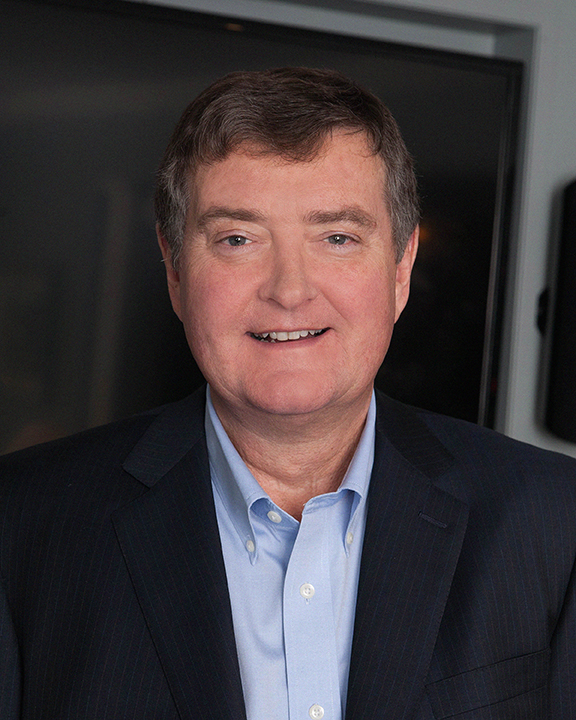
Dr. Blake Woodside
Specialty:
Psychiatry
About The Speaker
Dr. Woodside’s specialty in psychiatry is the treatment of eating disorders in adults, and family therapy of adolescent anorexia nervosa. He is a past Medical Director of the Program for Eating Disorders at the Toronto General Hospital, where he led the inpatient service for 25 years, and Professor in the Department of Psychiatry at the University of Toronto. A distinguished Fellow of both the Canadian and American Psychiatric Associations, he is also a clinical member and Approved Supervisor for the American Association of Marriage and Family Therapy, and a certified therapist and faculty member for the Behavioural Family Therapy Institute.
Dr. Woodside has an active academic career with a long history of grant support from many agencies and private foundations. His research activity presently focuses on novel treatments in eating disorders, including Deep Brain Stimulation, Repetitive Transcranial Magnetic Stimulation, and Family-Based Therapy. He has many other research interests including family issues, genetics, treatment outcome, human resource/economic issues and males with eating disorders. He has also been recognized locally and by the American Psychiatric Association for his contributions to undergraduate medical education. He has over 160 publications.
Dr. Woodside earned his medical degree from Queen’s University in 1982, his psychiatry degree from the University of Western Ontario in 1986, and his Masters of Science in 1990 from the Institute of Medical Science, University of Toronto.
Dr. Woodside currently practices in the Community in partnership with Dr. Leora Pinhas, an expert in Child Eating Disorders.
Dr. Woodside lives with his wife and three surviving children in Toronto.
CME Topics
Dermatology and Psychiatry
CME AWAY® by Sea Courses is pleased to invite you to an 11 Night CME Cruise in French Polynesia. Dr. Anne Curtis and Dr. Blake Woodside have developed an interactive educational program that will be of interest to family physicians, specialists, and allied health professionals.
Dr. Curtis is a Toronto dermatologist who has transitioned from a busy general dermatology practice to one in cosmetic and laser dermatology. She graduated from medical school at the University of Toronto in 1982 and was awarded the Cody Gold Medal for the highest standing over 4 years of medical school. In addition to her Canadian fellowships, she has her American Board certifications in Internal Medicine and Dermatology. Dr. Curtis teaches both medical students and dermatology residents and organizes a large dermatology journal club. Dr. Curtis’s topics will include Acne and Rosacea, Lumps and Bumps, Hair Loss, Nevi and Skin Cancer, Pruritis, Autoimmune Disease and Cosmetic Dermatology.
Dr. Blake Woodside’s specialty in psychiatry is the treatment of eating disorders in adults, and family therapy of adolescent anorexia nervosa. He is a past Medical Director of the Program for Eating Disorders at the Toronto General Hospital, where he led the inpatient service for 25 years, and Professor in the Department of Psychiatry at the University of Toronto. Dr. Woodside’s research activity presently focuses on novel treatments in eating disorders, including Deep Brain Stimulation, Repetitive Transcranial Magnetic Stimulation, and Family-Based Therapy. He has also been recognized locally and by the American Psychiatric Association for his contributions to undergraduate medical education. He has nearly 160 publications. Dr. Blakeside’s topics will include Eating Disorders, Anxiety Disorders, Depression, OCD, PTSD and New Treatments in Psychiatry.
Dr. Curtis and Dr. Blakeside are very much looking forward to seeing you in French Polynesia.
Dr. Curtis-
- Acne and Rosacea- an approach to treatment
- The participant will be able to manage a patient on isotretinoin- they will understand the indications, risks and how to monitor
- The participant will be able to treat a patient with rosacea- escalating appropriately from topicals, to systemics, to lasers
- How to Handle Itch- differential diagnosis and treatment
- The participant will be able to investigate a patient with pruritus and initiate treatment
- The participant will be able to differentiate between types of dermatitis and know how to adjust management appropriately
- Lumps and Bumps- what are they and what do I do
- The participant will be able to diagnose multiple different types of papules and discuss treatment options
- The participant will be able to diagnose and treat granuloma annulare
- How to Handle Hair Loss- diagnosis and treatment
- The participant will recognize frontal fibrosing alopecia and other forms of scarring hair loss and be able to initiate treatment
- The participant will be able to diagnose androgenetic alopecia and treat with an escalating ladder of topicals, orals and energy based devices
- Nevi and Skin Cancer- diagnosis and treatment
- The participant will learn to recognize different types of nevi and judge which require excision
- The participant will be able to manage actinic keratoses with a range of topical and oral treatments
- Cosmetic Dermatology- assessing and counseling patients
- The participant will be able to assess the aging face and recommend therapy for different types of degenerative change
- The participant will be able to counsel patients about the range of laser treatments available and what they can and can not achieve
- Autoimmune Disease in Dermatology- differential diagnosis and management
- The participant will be able to diagnose morphea and other types of scleroderma and initiate treatment
- The participant will be able to diagnose bullous pemphigoid and initiate treatment
Dr. Woodside-
- Introduction to Eating Disorders
- Identify the different types of eating disorders
- Identify early warning signs of eating disorders
- Managing Medical complications in Eating Disorders
- Identify common medical complications in Eating Disorders
- Be familiar with approaches to manage medical complications in Eating Disorders
- Anxiety Disorders in Family Practice Part 1
- Differentiate between common anxiety disorders
- Understand the principles of treatment for common anxiety disorders
- Anxiety Disorders in Family Practice
- Identify Obsessive Compulsive Disorder and Post Traumatic Stress Disorder
- Identify effective treatment strategies for both
- Understanding and managing Depression in Family Practice
- Separate depression from other common disorders of mood
- Have an approach to the treatment of depression
- Advanced topics in Anxiety and Depression
- Be familiar with augmentation strategies in Depression
- Be familiar with advanced options in treating Anxiety Disorders
- New treatments in Psychiatry
- Be familiar with modern neuroimaging techniques
- Be aware of cutting edge approaches in the treatment of psychiatric disorders
Venue Information
Refined elegance meets effortless immersion on Silver Whisper with amenities of a grand resort. The charms of a stylish boutique hotel, from spacious suites to sophisticated venues, each element of the onboard experience is crafted for comfort and connection. A ratio of nearly one crew member for every guest ensures your journey feels tailored to you. Revel in the pampering treatments of an expanded wellness spa and shop the hottest trends from top designers at our shipboard boutiques. Silver Whisper luxury cruise ship has it all. Design your own schedule … or no schedule at all … Silver Whisper.
Itinerary & Schedule
| Day |
Date |
Port / Location |
Arrival Time |
Departure Time |
Conference |
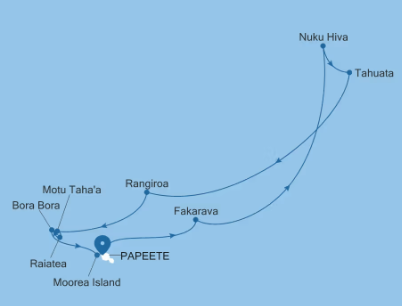
| Day 1 |
October 13th |
Papeete, Tahiti |
|
6:00pm |
|
| Day 2 |
October 14th |
Fakarava, Tuamotu Islands |
12:00pm |
7:00pm |
|
| Day 3 |
October 15th |
At Sea |
|
|
CME TBA |
| Day 4 |
October 16th |
Nuka Hiva, Marquesas Islands |
9:00am |
7:00pm |
|
| Day 5 |
October 17th |
Tahuata, Marquesas Islands |
8:00am |
5:00pm |
|
| Day 6 |
October 18th |
At Sea |
|
|
CME TBA |
| Day 7 |
October 19th |
Rangiroa |
9:00am |
4:00pm |
|
| Day 8 |
October 20th |
Raiatea, Society Islands |
10:00am |
10:00pm |
|
| Day 9 |
October 21st |
Bora Bora, Society Islands |
8:00am |
10:00pm |
|
| Day 10 |
October 22nd |
Motu Taha'a |
8:00am |
5:00pm |
|
| Day 11 |
October 23rd |
Moorea Island |
8:00am |
5:30pm |
|
| |
|
Papeete, Tahiti |
9:00pm |
|
|
| Day 12 |
October 24th |
Papeete, Tahiti |
|
|
|
Detailed Itinerary
Day 1 Papeete, Tahiti
Papeete is the center of the tropical paradise of French Polynesia, where islands fringed with gorgeous beaches and turquoise ocean await to soothe the soul. This spirited city is the capital of French Polynesia and serves as a superb base for further exploration of Tahiti - an island of breathtaking landscapes and oceanic vistas. A wonderful lagoon of crisp, clear water begs to be snorkeled, stunning black beaches and blowholes pay tribute to the island's volcanic heritage, and lush green mountains beckon you inland on adventures, as you explore extraordinary Tahiti. Visit to relax and settle into the intoxicating rhythm of life in this Polynesian paradise.
Day 2 Fakarava, Tuamotu Islands
Fakarava is oblong-shaped and has an almost continuous string of reef and motu stretching for 40 km (25 mi) on its eastern edge. It's the second largest of the Tuamotu atolls, located 450 km (280 miles) northeast of Tahiti and 120 km (75 miles) southeast of Rangiroa. It's renowned for the drift diving in its two passes - Garuae (also spelled Ngarue) in the north near the main town of Rotoava (and the airport) and Tamakohua Pass, 48 km (30 mi) across the lagoon in the south. The tiny village of Tetamanu, situated by the southern pass, was once the capital of the Tuamotus and houses the first church built in the archipelago in 1874. In 2006 the entire atoll was deemed a UNESCO biosphere reserve; to preserve the lagoon no overwater bungalows have been built in it. Fakarava was “discovered” by Russian explorer Fabian Gottlieb Von Bellingshausen in 1820; some 20 years later missionaries arrived, in the guise of fanatical Catholic priest Honore Laval, and began building churches.
Day 3 Day at Sea
Days at sea are the perfect opportunity to relax, unwind and catch up with what you’ve been meaning to do. So whether that is going to the gym, visiting the spa, whale watching, catching up on your reading or simply topping up your tan, these blue sea days are the perfect balance to busy days spent exploring shore side.
Day 4 Nuku Hiva, Marquesas Islands
Think of French Polynesia and you are automatically transported to the white sands of Tahiti, the blue seas of Bora Bora, or, at the very least, the iconic statues of Easter Island. Now, imagine a place that is home to that majestic trinity, but has no crowds and is full of island authenticity that is rare in these global times. You have just imagined Nuku Hiva. The island is the second largest after Tahiti in the archipelago but is yet to be discovered by tourism. As part of the Marquesas Islands, Nuku Hiva is technically French, but don't expect to find any blue-and-white striped shirts here! In fact, even though French is the “official” language of the island, a sing-song dialect of Tahitian mixed with Marquesan is more widely spoken. The younger generations also speak English. Undeniably, Nuku Hiva has been blessed by the gods. With towering mountains, eight magnificent harbors, and one of the world's highest waterfalls, Nuku Hiva is rich with Mother Nature's jewels. The island could lay claim to a great many claims to fame, such as its deep, unpolluted waters, its lush forests bursting with vitality, or its fascinating assortment of archaeological interests including tikis (sacred statues) and pae pae (stone platforms that formed the foundations of homes). Yet for those in the know, the island's primary claim to fame is that author Herman Melville deserted his ship to live among the natives of the island, and his books Typee and Omoo were inspired by his experiences on Nuku Hiva.
Day 5 Tahuata, Marquesas Islands
If you’re looking for a perfect incarnation of Polynesia’s unparalleled beauty, you just found it. Discover mesmerizing Tahuata and unveil all its secrets. Part of the Marquesas, this is the tiniest inhabited island of the archipelago, with only 700 inhabitants. This croissant-shaped piece of land was discovered in 1595 by Spanish navigator Alvaro de Mendana de Neira and has been a dreamy destination for many travelers since. Indeed, its spectacular and idyllic scenery, made of contrasts between impressive mountains and sandy beaches, would inspire every poet - and not only! How can’t you be impressed admiring Meae Ufa, a 3,181-foot volcano, and the stunning twin bays Ivaiva Nui and Ivaiva Iti? The island is also nicknamed Monoi Island - thanks to the great quality of its tiaré oil, heritage of traditions, and secrets orally transmitted generation to generation. Tahuata has a huge reputation across French Polynesia for another savoir-faire, its rich craftsmanship. The craftsmen excel at carving beautiful pieces, spears, puzzles, dishes they produce on bone or rosewood. These unique creations are exhibited in the craft center of the pretty village of Hapatoni and in the Vaitahu Town Hall Museum. Very close to one another (15-min boat ride or 30-min walk), these two tiny villages are absolutely worth a visit with their charming mix of Polynesian and European atmosphere. And don’t forget to have a swim at Hana Moenoa Beach, the island’s most beautiful one. Maybe you’ll come across sea turtles in its crystal-clear waters.
Day 6 At Sea
Day 7 Rangiroa
Rangiroa is French Polynesia’s largest atoll. More than 400 motu (islets) enclose the lagoon, which is so wide and long that one cannot see the southern row of motu from the two main islets in the north - hence the local name Rangiroa meaning wide or long sky, sometimes taken as ‘immense sky’. There are several passes from the ocean into the lagoon and the two main villages of Avatoru and Tiputa are located next to the passes of the same names. Drift diving and snorkeling the incoming tides looking for sharks and manta rays at these passes is one of Rangiroa’s main touristic draws. Government jobs, ecotourism and pearl farming are the main sources of income on the atoll. The lagoon’s calm turquoise waters, rich marine underwater world, and relaxed atmosphere attract visitors year-round to the many local guesthouses and a few hotels. Both Avatoru and Tiputa also feature schools for the other Tuamotu Islands which have no higher education possibilities. One of Rangiroa’s most unusual attractions is the white and rose wine produced on the islet immediately west of Avatoru - the wine has won several awards.
Day 8 Raiatea
Known as the ‘Sacred Island,’ Raiatea is a fascinating haunt for archaeologists and historians as it's one of the islands in the Pacific where Polynesian culture can trace its roots. Visitors will find many of the older Polynesian structures still in place and are fascinating places to explore. In the 16th century, Raiatea developed a powerful cult dedicated to Oro the God of War, and built a large meeting ground, the Taputaputea Marae, which is still intact. Human sacrifice was practiced until around the middle of the 18th century and visitors should look for the sacrificial stone. Several tour operators run visits to the marae (ancient temples) along with some degree of informed commentary - although in fairness Polynesian storytelling can embellish things a little. The Faaroa River is the only navigable waterway in French Polynesia, and it can be traveled by powerboat or outrigger canoe. Running through the Faaroa Gorge it passes some spectacular scenery with steep-walled jungle foliage holding dozens of bird species and wild hibiscus. Trekking up Mount Temehani, a well-known landmark that's said to be Oro's birthplace, is relatively demanding. Keep a lookout for the rare, five-petal tiare apetahi. Said to be impossible to grow anywhere else, this white, indigenous flower can only be found above 1,300 feet (396 meters). Look, but don't touch. It's against the law to pick them.
Day 9 Bora Bora
If you have ever dreamed up your ideal island holiday, we suspect it goes something like this: Soapy blue seas? Check. Sparkling white beaches? Check. Thatched wooden huts, gently sloping palm trees, and kaleidoscopic marine life? Check, check, and check. And yet, even by ticking every box, first-time viewing of Bora Bora still beggars belief. This tropical hideaway less than 12 square meters in the heart of the South Pacific has been topping travel wish lists for years. Long considered the realm of honeymooners - spectacularly romantic sunsets are a specialty - Bora Bora is not just for wandering with your love. If the prismatic shades of blue of the world's most beautiful lagoon do not fill you up, then perhaps underwater scooters and aqua-safaris will charge your batteries. If exploring Bora Bora's lush hinterland is more your glass of tequila sunrise, then trips around the island are a must. Bora Bora's peaceful ambiance has not always been the case. The island was a U.S. supply base, known as “Operation Bobcat,” during WWII. During this time, Bora Bora was home to nine ships, 20,000 tons of equipment, and nearly 7,000 men. Eight massive 7-inch naval cannons were installed around the island, all but one of which are still in place. Although little is known of the history of the island, it is known that Bora Bora was called Vava'u in ancient times. This supports the belief that the island was colonized by Tongans before French annexation in 1888.
Day 10 Motu Taha’a
Motu Taha'a is a small private islet near the island of Taha’a in the South Pacific, known for turquoise lagoons, coral reefs, and luxury overwater bungalows. It’s a popular spot for snorkeling, kayaking, and quiet tropical getaways.
Day 11 Moorea Island
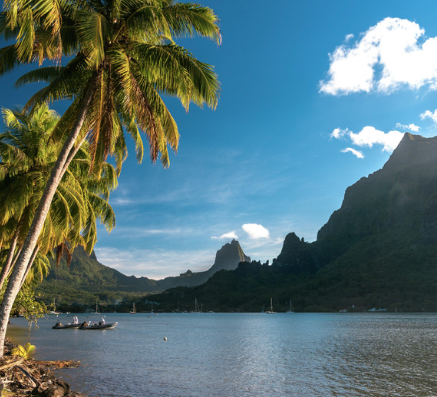
Moorea is a high mountainous island with two nearly symmetrical bays found on the north coast. The island's triangular shape has been likened to a heart or a bat. Eight mountain peaks reaching a height of up to 1,207 meters give Moorea a very rugged silhouette. The reef surrounding the island encloses a narrow lagoon - a RAMSAR Wetland - and has barely any motu (reef islets). Sharks and rays are some of the lagoon's attractions. The island is only one-eighth the size of neighboring Tahiti and has a more relaxed lifestyle. A road leads around Moorea, passing small villages with their churches and the resorts and smaller hotels mainly found on the north coast. A detour into the interior will show large pineapple plantations, French Polynesia's only agricultural school, ancient marae (stone platforms), and splendid views of the island from Belvedere above Cook's Bay. Many of the 18,000 residents work in Tahiti, taking one of the ferries plying between Vaiare on the east coast and Papeete. This led to Papeete being one of France's busiest ports in passenger volume. Foreign visitors either come into Temae airport, tucked in-between the Green Pearl golf course and Temae's public beach, or by ship entering one of the two bays on the north coast. Both bays are connected to Captain Cook's visit in 1777: he stayed in Opunohu Bay, but to honor him Pao Pao Bay has been named Cook's Bay.
Day 11 & 12 Papeete, Tahiti
You will arrive into Papeete in the evening for your last night on board Silver Whisper. In the morning of Day 12/October 24th, you will disembark after a bucket-list journey through French Polynesia.
Note: Itinerary schedules are subject to change due to factors including water levels, public holiday closures, and other unforeseen circumstances. While every effort will be made to operate the program as planned, adjustments may be necessary before or during the cruise. Please refer to your final cruise documents prior to sailing for the most up-to-date schedule.
Pre-And-Post Conference Information
There are no pre or post tours created for this itinerary. To build your own or to simply add hotel nights, please speak with your Advisor.

 1-800-268-3273
 cruises@seacourses.com